
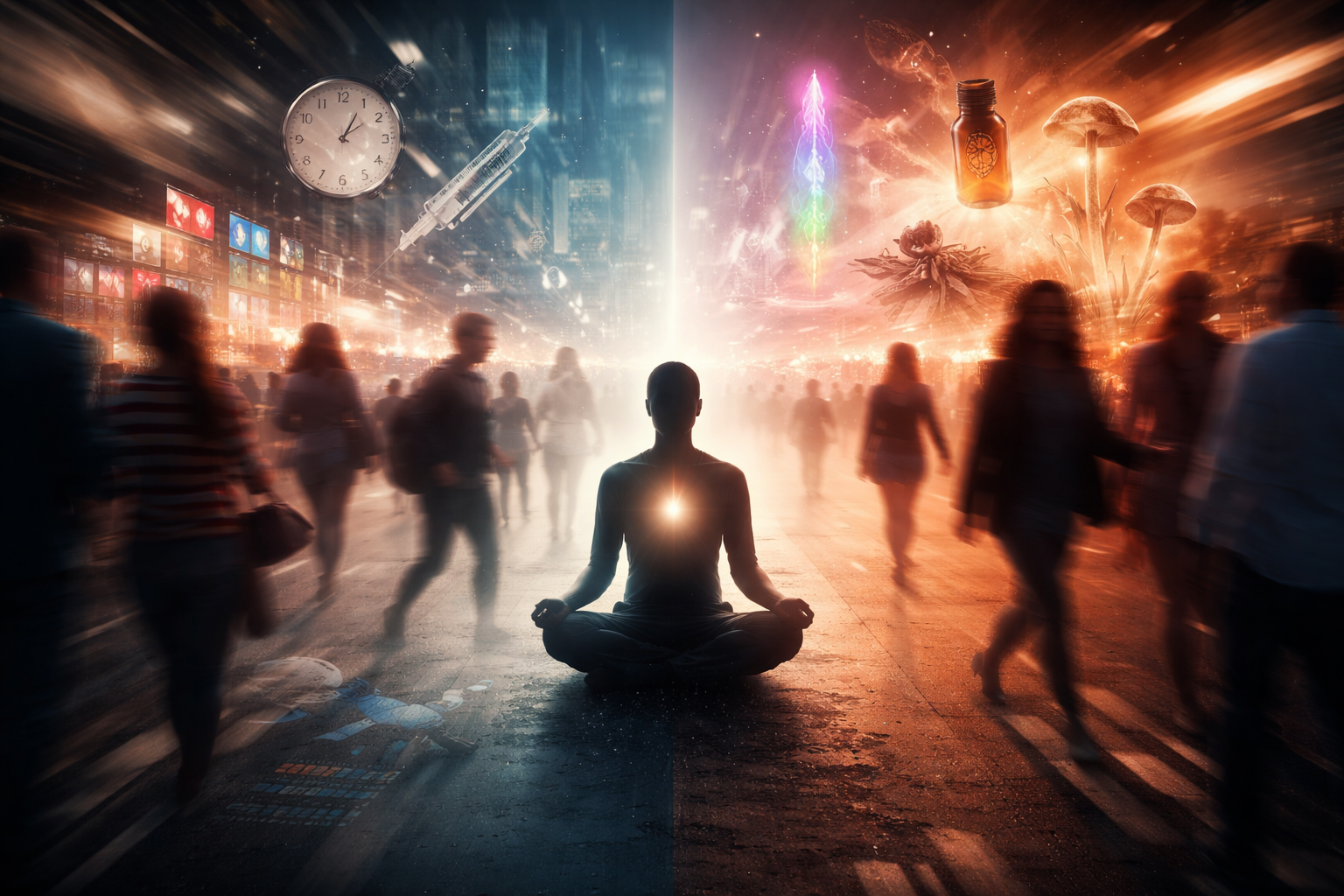
I saw Donald Trump on the news the other day. He had just signed a measure to fast-track psychedelic therapies. Shortly after, he said something along the lines of, “I don’t have time to be depressed. I stay activated and busy. Maybe that’s what really helps.”
Many people might hear that as strength. But that wasn’t the first time I heard that idea that week. A few days earlier, I met a friend who had just ended her relationship, and in the middle of the conversation she said, “I don’t have time to be sad.”
Different worlds, different contexts, but the same pattern. We don’t have time to feel.
We Don’t Have Time Anymore
We don’t have time to feel heartbreak, to process loss, or to sit in uncertainty. So we move. We distract ourselves, we push forward, we stay on. Because stopping feels more dangerous than continuing. Slowly, this becomes normal. Not feeling begins to look like strength.
A Society That Runs Instead of Feels
This is not about one person. It is cultural. You see it everywhere: constant productivity, endless stimulation, fast emotional reactions, and very little space to integrate what we go through. We have learned to function and to perform, but not necessarily to feel.
The Age of Quick Fixes
And when the system starts to crack, we don’t slow down. We fix. We optimize the body, adjust the surface, and regulate what is visible. From Botox to biohacking, the message is consistent: don’t feel it, fix it. And this doesn’t stop at the physical level. It has entered the spiritual world as well. Not feeling has simply become more sophisticated.
And sometimes, it even looks like growth, like we are becoming something new, but often it is just another layer—another identity built on top of what we already feel, rather than the capacity to actually stay with it. This happens often in retreats. We experience something powerful, a sense of breakthrough, clarity, or openness, and for a moment it feels like something has truly changed. But slowly, as we return to daily life, the old patterns come back. Not because the experience wasn’t real, but because the system does not yet have the capacity to hold it.
When Healing Becomes Fast Too
Now even healing is entering the same pattern. Substances like psilocybin and MDMA are currently being studied in clinical settings and have received growing attention from institutions such as the U.S. Food and Drug Administration for their potential in treating conditions like depression and post-traumatic stress. Early research is promising, and in controlled environments these substances can facilitate emotional access, loosen rigid patterns, and allow experiences that might otherwise feel out of reach.
I am open to this. In the right context, with proper guidance and integration, these approaches can be meaningful and, for some, deeply supportive. But there is a deeper question we are not asking. The narrative quickly becomes that this could fix it, that this could be the breakthrough that changes everything.
And yet, something essential is often overlooked. From a nervous system perspective, opening is not the same as stabilizing, and access is not the same as integration. A temporary shift in perception does not automatically translate into a lasting change in how the system regulates itself over time. The real question is not only what these experiences reveal, but whether the person has the capacity to embody and sustain what was accessed once the experience is over.
Opening Is Not the Same as Holding
These substances can open perception and bring emotion, connection, and insight to the surface. But after the experience ends, a more important question remains: can you stay with it? Can your nervous system hold what was opened? Because without that capacity, the system closes again.
Activation Is Not Strength
Staying activated can look like success, confidence, and control. But often, it reflects an inability to stop—an avoidance of stillness and of feeling. A system that cannot slow down safely is not free. It is trapped in movement.
The issue is not that we feel too much, but that we do not have the capacity to stay with what we feel. So we move between constant activation and quick relief, without ever developing the ability to simply be.
The B-Evolution Perspective
At B-Evolution, the focus is not on chasing better states or avoiding difficult ones. It is about building nervous system capacity—the ability to feel without escaping, to stay without collapsing, and to activate without losing control. Real transformation is not a moment or an experience; it is what you can live consistently in your daily life.
Final Reflection
Maybe the problem is not that we don’t have time to be depressed. Maybe it is that we have created a way of living where feeling no longer has enough space. So we stay activated, not because we are strong, but because we no longer know how to stop.
B-Evolution
Frode