
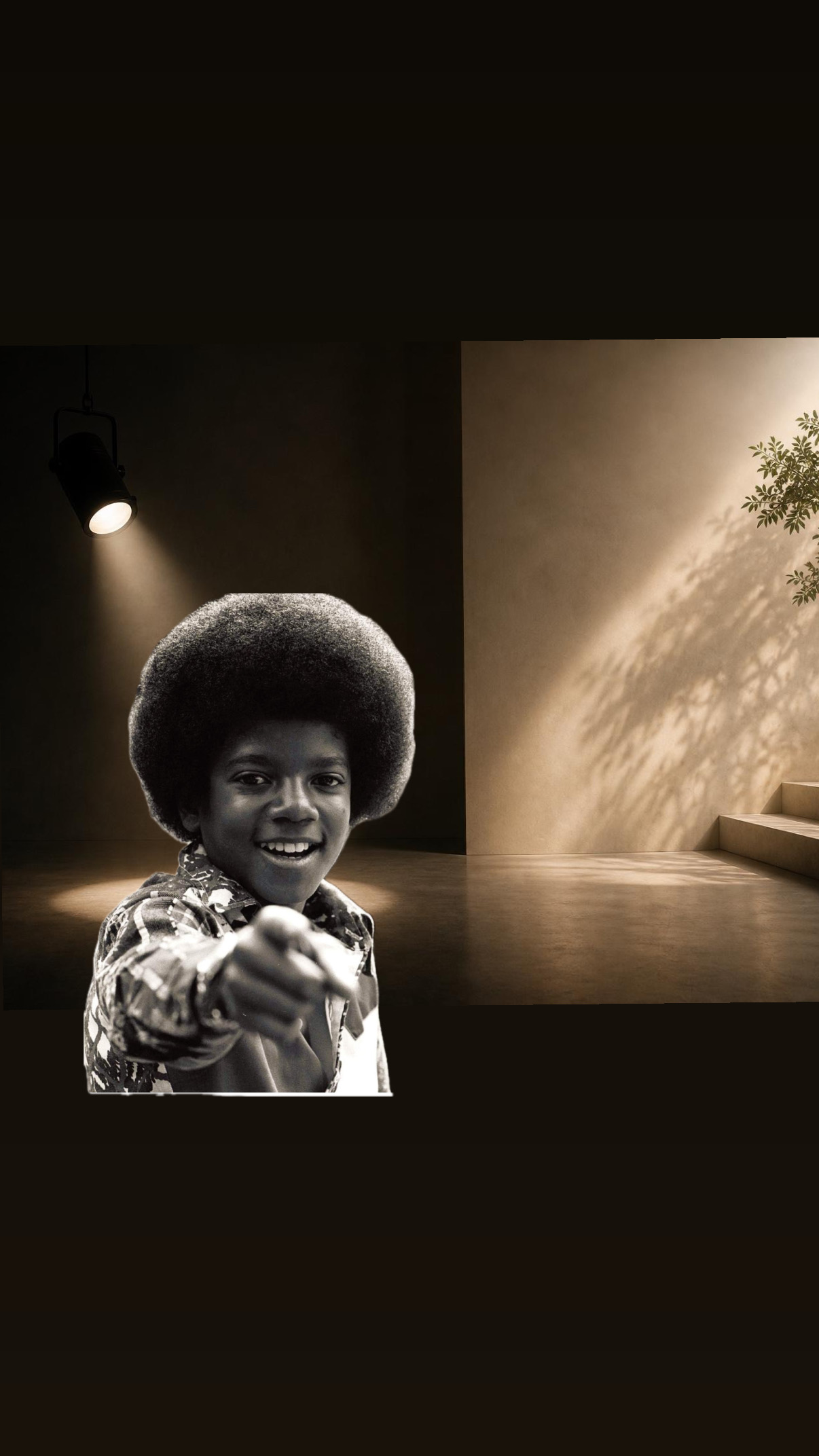
We went to the cinema last night to watch Michael. We arrived fashionably late, but still had time to grab popcorn, sweet and salt. Before the movie started, I looked at her, smiled, and caught myself thinking—the girl is mine ☺️
We both love Michael Jackson, the music, the brilliance, the performance, but sitting there, watching his life unfold, a question arose, and this article began to take form. Not about the artist, but about the human behind it.
What if what we admire…
has very little to do with what actually creates happiness?
The Question Beneath the Spotlight
Like us , the world is about to watch Micheal—a story of greatness, talent, and impact. But beneath the performance, there is a quieter question: Was he happy? And maybe even more uncomfortable: Are the people we admire actually okay? Because what we see is performance, while what we don’t see is the state behind it.
The Illusion of Performance
Performance is powerful. It creates admiration, identity, and value in the eyes of the world. But performance is not the same as being. Performance is what the world sees; happiness is what the system feels. And those two are often completely disconnected.
When Performance Becomes Identity
For many people, performance doesn’t stay on the stage. It becomes the way they are loved, accepted, and ultimately how they survive. In the life of Michael Jackson, we saw a human being shaped in front of the world—early, intensely, and without pause. Not just expressing, but adapting.
There is a sentence often associated with his inner world: “I was so lonely I would cry in my room upstairs.” The stage was full, but the room was empty.
And behind that inner world, there was also a message shaping the system from the beginning, coming from his father: “In this life, you’re either a winner or you’re a loser.”
When a nervous system grows inside that kind of polarity, something very specific happens. Love becomes conditional, worth becomes performance, and safety becomes achievement. Authenticity becomes risky. So the system learns: I am safe when I deliver.
The Nervous System Behind Success
From the outside, success looks like fulfillment. From the inside, it can feel like pressure. Because the nervous system does not measure applause, status, or recognition—it measures safety. And if safety was never felt without performance, then performance becomes the only way to regulate.
But it never truly works. Because what is needed is not more success, but more capacity. You can be celebrated by millions and still not feel at home in yourself.
The Hidden Cost of Always Delivering
What we often call drive, discipline, or perfectionism can be something else entirely: a system that cannot rest, a system that cannot drop the role, a system that has learned, “If I stop performing, I disappear.”
This is not simply ambition; it is adaptation. A response to an environment where being was not enough. Performance can create admiration, but it cannot create inner stability.
True Happiness Is a Capacity
True happiness is not something you achieve. It is something your system can hold. And that requires something performance can never give: regulation, capacity, and internal safety.
Happiness begins where performance is no longer needed—where you don’t have to prove, deliver, or maintain an image, where you can simply be without losing connection.
The Mirror
The story of Michael is not just about one person. It is a mirror. Because performance does not only exist on stages—it exists in relationships, in work, in identity, even in spirituality. Many people are not living as themselves; they are living as the version that was rewarded.
Closing Reflection
So the real question is not about him. It is about you:, about us.
Who are we when we are no longer performing?
And more importantly:
Does our system feel safe enough for us to look at the woman—or the man—in the mirror?
Frode