
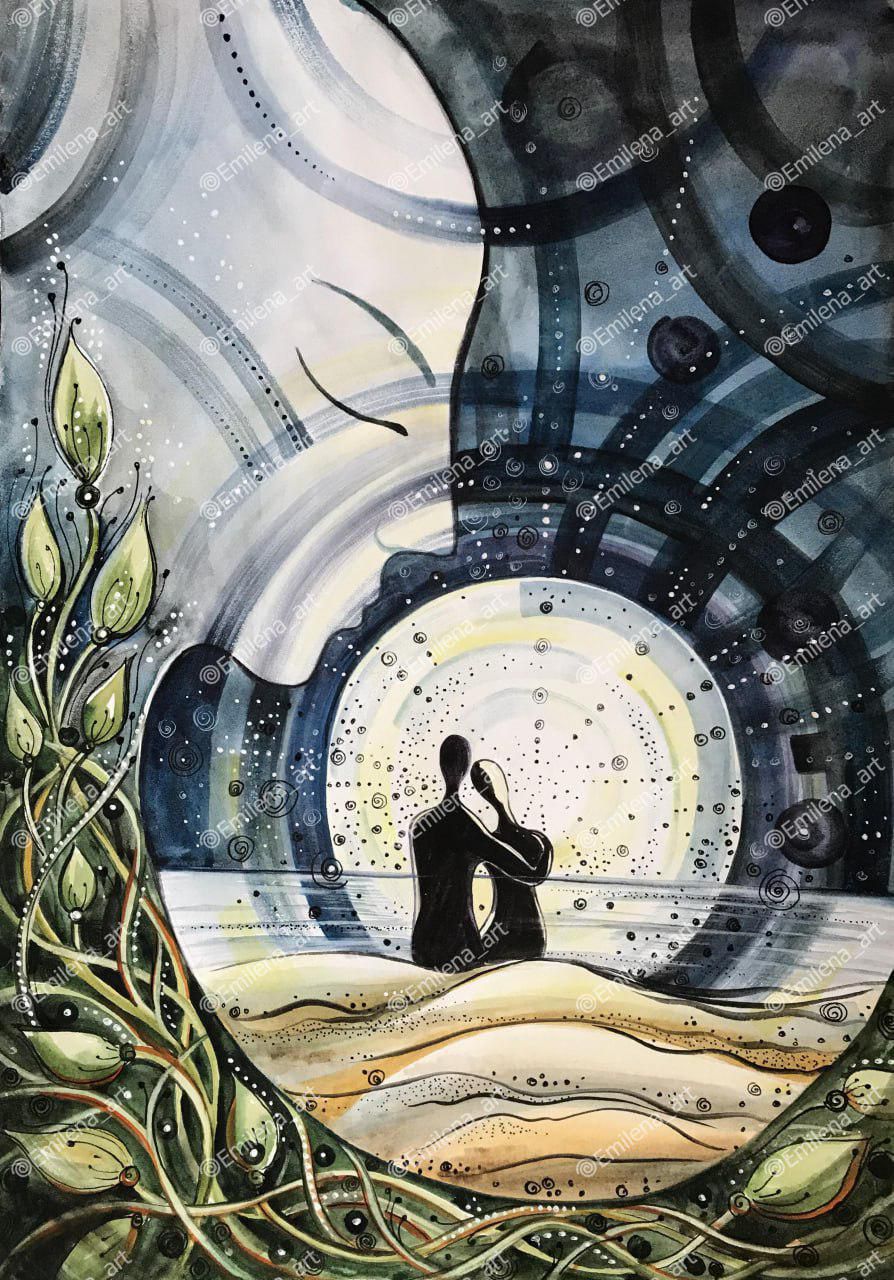
Marriage is one of the oldest social structures we have.
For centuries, it organized love around survival. Stability. Roles. Security. Continuity. It created predictability in uncertain environments and reduced chaos in fragile societies. It gave families order and individuals a defined place in the system.
And for its time, it made sense.
When life was physically demanding and socially unstable, marriage was not primarily about romance. It was about protection. About shared responsibility. About raising children within a stable frame. It was a structure that regulated uncertainty from the outside.
The nervous system relaxes when there is predictability. When roles are clear. When expectations are defined. Structure holds what internal capacity cannot yet hold.
But something is changing.
We are no longer evolving only through survival. We are evolving through capacity.
The deeper question may not be whether marriage is outdated. It may be whether the way we inhabit marriage is evolving.
From External Security to Internal Safety
Traditionally, marriage protected the bond through structure. Roles defined safety. Expectations defined stability. Performance maintained order. As long as each person fulfilled their role, the system held.
This model can still work. But when safety depends entirely on structure, it remains fragile. If roles shift, if identity evolves, if expectations are not met, the system destabilizes.
External organization can only regulate so much.
Old role-based security and felt security may look similar from the outside. Both can create calm and continuity. But they arise from different places.
Role-based security is external. It says that if responsibilities are clear and agreements are honored, safety exists. The nervous system relaxes because uncertainty is reduced. But that relaxation depends on the structure holding.
Felt security is internal. It does not depend primarily on roles, but on regulation. The body feels safe because it has the capacity to stay present even when roles shift, conflict arises, or uncertainty appears.
Instead of feeling safe because the other fulfills a role, safety emerges because the system can remain regulated in contact.
Safety moves from outside to inside.
When that shift happens, structure becomes supportive rather than compensatory.
The Reaction Against Structure
When traditional marriage feels restrictive, rebellion often follows. Free love, autonomy, and the refusal to be confined by inherited roles emerge as reactions. This movement restores individuality and questions unconscious loyalty to the past.
But when rebellion is reactive, it is still organized around protection. Distance becomes the new safety strategy. Commitment feels like loss of self. Closeness feels threatening.
Externally, love may look free. Internally, the nervous system may still be defending.
Removing structure does not automatically create capacity.
Marriage as a Developmental Container
If marriage is evolving, it is not because structure disappears. It is because the organizing principle shifts.
Marriage becomes less about locking in security and more about supporting maturation.
Two people choosing to grow together.
Two people who recognize when they are in protection. Two people who can feel activation without turning the other into the enemy. Two people aware of their frightened parts and their loving parts, choosing regulation over reaction.
This kind of partnership is not organized around drama or survival bonding. It is organized around safety, capacity, and evolution.
Conflict becomes information. Discomfort becomes material. Commitment becomes participation rather than obligation.
The B·Evolution Arc of Relationship
From a B·Evolution perspective, relationship follows a natural arc of maturation.
From survival bond
Connection organized around safety and protection.
To role-based stability
Structure creates predictability and external security.
To reactive freedom
Rebellion against confinement and inherited roles.
To embodied capacity
Safety becomes internal. Regulation replaces control.
To conscious commitment
Two regulated individuals choosing growth and co-creation.
This movement is natural, but it is not automatic.
And it is not mandatory.
It is not marriage itself that evolves, but the capacity of the individuals inside it.
Not every marriage or relationship needs to move through all these stages. Many remain stable in survival bonding or role-based structure for a lifetime. If both partners feel aligned within that structure, it can function well.
There is no hierarchy here. Earlier stages are not wrong. They simply reflect the level of internal organization available.
Development becomes relevant when internal capacity begins to outgrow the structure holding it.
A relationship can remain where it is.
It can deepen. Or it can reorganize.
Its depth will always mirror the capacity of the two people within it.
And capacity grows only when it is lived.
When Growth Becomes Uneven
Sometimes capacity increases on only one side.
When that happens, the bond cannot remain unchanged. It may stretch. It may contract. Or it may reorganize completely.
What we call a break-up is not always failure. Sometimes it is the honest recognition that two people are no longer evolving in the same rhythm.
This does not mean the love was false. It does not mean someone was wrong. It may simply mean the relationship carried both people as far as it could in its current form.
Growth can feel lonely. One partner may feel unseen in their expansion. The other may feel pressured or left behind.
Underneath both experiences is vulnerability.
And sometimes, despite care and effort, the directions do not align.
Separation then is not punishment.
It is clarity.
Not a rejection of love,
but a recognition that love alone cannot carry what only shared capacity can sustain.
Sometimes endings are not failures.
They are part of the unfolding.
And sometimes letting go
is the most respectful form of love available.
So Is Marriage Old or Evolving
Marriage as a rigid structure may belong to another era.
Marriage as a developmental container may be just beginning. The form may remain. The ceremony. The shared life.
But the organizing principle is changing.
From protection to participation.
From roles to regulation.
From control to consciousness.
Marriage does not have to disappear.
It may simply need to mature.
To shift from being a contract for safety to being a container for growth. From something we enter to feel secure to something we enter to expand.
So maybe the real question is no longer only,
Will you marry me?
Maybe the deeper question is,
Will you grow with me?